Keynotes and workshops on inclusion, AI, and leading through change, for audiences that leave with a framework they use, not just a good feeling. Funny-first and story-driven on the surface; 28 years of HR and governance, and a seat at the board table, underneath.
Inclusion & neuroinclusionAI at workLeading through changeReconciliation in HRResilience
Stage footage is being filmed now. Until it is up, book a short call and hear the material live.
Reel coming soon
Experience28 years across public and private sector · Crown corps, oil & gas, transit, tech & media
GovernanceC.Dir. · five boards across aviation, oil & gas, higher ed, Indigenous economic development & non-profit · vice-chair of a diversified Indigenous holding company
OwnerContour North & Island Parent Media
RecognitionCanadian HR Awards finalist · Use of Technology
FacilitationRunning instrument-based sessions since 2014 · Qualified in 10+ tools, including MBTI®, DiSC®, Five Behaviors®, Lumina Spark®, Thomas-Kilmann (TKI®), FIRO-B® and Psychometrics 360
She’s read the organization from every position, from the front line to the boardroom to owning the company. That’s why she can meet any level in your audience where they are.
Signature talks
Four keynotes, each with a framework you keep.
Starting points, not scripts. Each one is shaped to your audience, your room, and the outcome you’re booking it for.
Keynote / Breakout · Flagship
Route Choice
Building teams where difference works.
We spent decades learning to include who people are. We never learned to include how people work, and that’s where team performance lives. Every engagement survey names the same pain year after year, then hands it back to leaders with no tool to treat it. Ellice’s answer is a different theory of inclusion: the difference itself isn’t the asset, the conditions are. Drawing on 28 years in HR, and on orienteering, a sport where the course itself is authored, she gives leaders the practical moves to build a team where different people do their best work, without lowering the bar.
THE MOVES: Author the environment · Draw the real boundaries · Fit without lowering the bar · Fit and stretch · Be the mirror
Keynote / Breakout
Prove It
Recruit for thinking, not pedigree.
AI has made resumes and credentials unreliable. Applications are increasingly written by AI and increasingly screened by AI, so the paper has stopped being evidence on either side.
Ellice knows what a transcript can hide, because hers says “required to withdraw”, and she went on to two degrees, an MBA, and North America-wide HR leadership.
The research moved as well. A 2022 re-analysis overturned twenty-five years of selection orthodoxy: the strongest predictors of performance are job-specific, and structured interviews now outrank the general aptitude testing most organizations were sold.
THREE CHANGES: Ask every candidate the same questions in the same order · Give them a piece of the real work · Score independently before anyone discusses
The third one is where most panels lose the signal they just spent an hour collecting.
Keynote / Breakout
All or Nothing
What a brain diagnosed at 49 taught me about how we waste people.
Ellice was diagnosed with ADHD at 49, after a career spent managing other people’s performance. She had her own bias about what the diagnosis meant, and had to work through that before she could use it.
Looking back, the traits she had spent years managing around were the same traits that made her good at the work. The flaw and the strength are the same trait, which is why you cannot remove one without losing the other.
The research has moved the same way. Neuroinclusion is now a question of work design and management capability, not awareness.
THREE QUESTIONS LEADERS LEAVE WITH: What is this person unusually good at? · What conditions produce that? · Who else needs those conditions?
That last question is where it stops being an accommodation and starts being how the work is designed.
Keynote / Breakout
Who Decides?
When no one’s sure who decides, nothing moves.
Most organizations think they have a strategy problem or a people problem. Often it is a governance problem they have never named: decisions bounce around, get relitigated, or just sit, because no one is clear who owns them, where the board ends and management begins, or what the rule was last time. From her seat as a C.Dir. on five boards and on the management side trying to get things done inside the org, Ellice gives leaders a plain way to make governance clear enough to move.
FOUR MOVES: Name the decision · Find the owner · Draw the line between board and management · Write down what was decided
The fourth is what stops the same decision being made three times.
More sessions
Breakouts, workshops & panels
Breakout
Leading HR Through Reconciliation
A practical starting point that goes past a land acknowledgement, from an Inuvialuk HR leader who has done the work inside institutions.
Breakout
AI at Work: From Curiosity to Capability
A practical, grounded starting point, from someone who builds working AI systems day to day.
Workshop
Recognition Is a Broken Feedback Loop
Recognition isn’t a pizza party, it’s a system you can engineer. Anchored by a recognition system that took nominations from 117 to 266 in a year and made her a Canadian HR Awards finalist for Use of Technology.
Workshop
Stop Accepting Broken Systems
The builder’s talk: seeing a system where others see a process, and shipping the fix.
Workshop
Performance: Lead From a Place of Help
“If you only want to walk someone out the door, look in the mirror.” Yes, she was once hugged at the end of a termination she conducted.
Workshop
Disability Management & the Duty to Accommodate
How the duty to accommodate plays out in practice, and where to bring in counsel, from an HR leader with a Labour Relations background. Solo, or panelled with a clinical partner.
Workshop
Building High-Performing, Cohesive Teams
Shared language for trust, conflict, and accountability, from a certified Five Behaviors & DiSC facilitator.
Panel
Indigenous Governance & Board Leadership
What good governance looks like inside Indigenous institutions, from a C.Dir. who has served on those boards.
Workshop
Critical Thinking for HR & People Leaders
A framework for slowing down high-stakes decisions before they go wrong, the defining skill of the AI era.
The personal keynote · Resilience
Getting to the Last Control
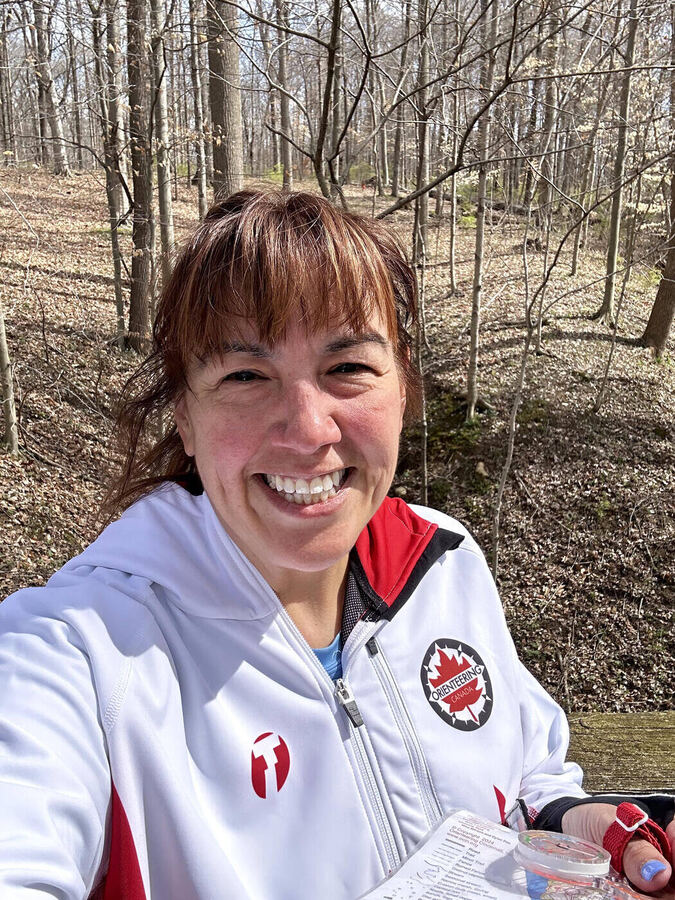
A lost beginner in her late forties, she took up orienteering in 2020, something to do when COVID shrank the world. A gloriously messy first season followed, falls, wasp stings, starting out against seven-year-olds and "first and last in a class of one", and then, in 2025, she raced her own age category at the World Masters Orienteering Championships in Spain. A story about late starts, recovering from mistakes out loud, and redefining the finish line, with ADHD cues written on her hand the whole way.
“Sometimes the win isn’t about speed, it’s about getting to that last control, no matter how wild the journey.”
WHAT THE ROOM TAKES: It is not too late to start · You can be bad at something out loud and keep going · You decide what finishing means
Determination is the hallmark of every story Ellice tells: the standby seats she negotiated for a degree a dean said was over, a transcript stamped “required to withdraw,” a last control on a wild course. How each one turns out is the talk. Runs on its own, or woven into any talk above. Audiences: leadership groups, wellness events, educators, healthcare.
World Masters Orienteering Championships · Spain, 2025
Who’s in the room
Built for your audience.
Every talk is adapted to the room in front of it. Ellice speaks to:
Leadership teams & executivesHR & people conferencesAssociations & member eventsPublic-sector & Indigenous organizationsHealthcare, education & wellness
What your room leaves with
What they walk out holding.
A named model they keepShared language for how people workPermission to lead differentlyConcrete first movesA story that sticks
Booking · What event organizers get
Easy to book, and built to last past the day.
01
A real conversation first
A short call to understand your audience and what you want people to walk away with.
02
Content built for your event
Talks adapted to your audience and format. Keynotes run 45 to 75 minutes. Half-day and full-day workshops on request. Three months of notice is ideal. Ask anyway if your date is sooner, last-minute is sometimes possible.
03
Easy logistics
Bio, headshot, and AV requirements provided ahead of time. No back and forth required.
04
Everyone leaves with something
The guide that matches the talk is on our site for anyone who was in the room. Nobody has to take notes to keep it.
05
A session thirty days later
Available on request. Sixty minutes, virtual, with the people who have to do something differently. That is usually where the change lands.
06
The same person can do the work
Contour North is a practising advisory firm. If the talk surfaces something real, you are already talking to the person who can help you fix it.
Keynote $5,000 to $9,000 in person, $2,500 to $4,000 virtual. Half day $5,000 to $8,000. Full day $8,500 to $12,000. Panels, moderation and breakouts are quoted with the main engagement. Travel from Victoria, British Columbia, additional. Fees flex with the organization and the event, so tell us your budget and the shape of the day and we’ll tell you honestly what fits. We bring our own videographer and film the stage, not the room; tell us at booking if that is difficult at your venue. Full rate sheet (PDF) →
No form required
The speaker one-sheet
Everything an organizer needs on one page, talks, formats, bio, and photo. Download it, forward it, print it. If you’re booking a speaker, we’re not going to make you fill out a form first.
Most organizers want to talk to a speaker before they commit, so let us start there. Tell us about your event, audience, date, and what you want the room to walk away with. We’ll take it from there.
 Ellice · CPHR · MBA · C.Dir.